
Johnson County Court Calendars Explained
There is no single county-wide calendar here. District Court dates live in the Johnson County Tyler/Odyssey case record. Each judge's coordinator manages them. County Courts at Law keep their own settings. Justice of the Peace and municipal courts set the dates for cases filed with them. The specialized Child Protection Court posts a separate date selector through the Texas Judicial Branch. So a Johnson County court calendar is a stack of venue-specific schedules. It is not one master list.
Work from the newest event in the case register first. Then check the settings or Events and Hearings block. Then confirm with the court coordinator or clerk by phone. Old dates are still useful history. Yet they can linger in the record after a continuance. Write down the court, judge, time, room, and setting type as one bundle. That way nothing gets lost.
Johnson County Tyler Hearing Events
For county and district cases, the Johnson County Tyler public portal is the main online calendar route. Search for the case and open its detail page. Read the Register of Actions along with Events and Hearings. The case header names the assigned court and its status. Depending on what was entered, a hearing entry may carry a date. It may also carry a time, event label, notes, room, or judicial officer.
Never stop at the first date you see. A chronological record can hold a passed setting, a reset, and the replacement after it. Read the later entries and any linked order. If the current setting stays unclear, save the case number and call the assigned coordinator. The portal gives context. The court controls the live schedule.
Finding Your Court Date
First, identify the venue printed on your notice, citation, or pleading. Felonies and district civil or family matters route to the District Clerk. County-law misdemeanors, probate, and assigned county civil matters go to the County Clerk. A JP or municipal case stays with that precinct or city clerk. That choice of office matters. When a date truly matters, use every channel available.
- Open Johnson Tyler and select the right case family, or use the city or JP route named on a citation.
- Search by case number when possible. A party name, citation number, or attorney can be a fallback.
- Open case detail and compare the newest register entry with Events and Hearings.
- Call the District Clerk at 817-556-6839, County Clerk at 817-556-6323, or lower-court clerk if the portal fails.
- Ask the coordinator to confirm the date, time, courtroom, judge, and setting type.
- Use the Guinn Justice Center clerk counter for unresolved district or county matters.
Another option exists for registered users. It is re:SearchTX, where you can search under Hearings, Cases, or Filings. Think of it as a statewide research layer rather than a substitute for local confirmation. If counsel represents you, ask them to verify the setting directly. Courtroom postings and docket call can settle things on the day itself. But neither proves in advance that an older Johnson County hearing date still stands.
Johnson County Coordinator Check
Need a hearing date in a specific district court? Call the coordinator who handles that docket directly. The 18th District Court page lists two of them. Civil coordinator Teresa Steed takes calls at 817-556-6193, while criminal coordinator Megan Braucht handles the criminal docket at 817-556-6820. For a case assigned to that court, either line beats a general records inquiry at the clerk's office.
Best confirmation: Give the coordinator the case number, court, setting label, and shown date. Ask whether a signed reset or later action changed it.
Different court, different clerk. A County Court at Law runs its own docket. So does a JP court, and so does a municipal court. Each works through its own official channels. A District Clerk employee has no say over a city citation calendar. Likewise, a municipal clerk cannot set a district civil motion. So match the venue first. Then contact the office that actually keeps that court's calendar.
How to Read a Court Setting
For a different district court, a County Court at Law, a JP court, or a municipal court, go through that venue's own official clerk. Each office controls its own calendar. A District Clerk employee does not manage a city citation schedule. A municipal clerk does not set a district civil motion.
| Date | The scheduled day; compare it with later reset or continuance entries. |
|---|---|
| Time | The docket-call or individual start time, which may differ from when testimony begins. |
| Courtroom | The listed room and building; confirm when blank or changed. |
| Judge | The assigned court or judicial officer when published. |
| Setting Type | Arraignment, pretrial, motion, status, plea, trial, or another calendar purpose. |
Match every field to the same case number. A bare date is easy to confuse with a filing date or an old hearing. Before trusting a short label, read any notes or linked order in the register.
Johnson County Setting Terms
A short event label can hide a big distinction. Let the later orders and notes tell you what happened, not the calendar label by itself.
- Docket call
- A calendar-management setting where parties may announce readiness, status, plea plans, or a reset request.
- Pretrial
- A setting for motions, discovery, readiness, settlement, or plea discussion before trial.
- Continuance
- A court-approved move from one setting to another.
- Reset
- A replacement date; the prior event can remain in the historical register.
- Disposition
- The recorded outcome, different from a setting scheduled to seek that outcome.
Johnson County publishes no universal docket-code glossary. When a term is unclear, request the linked order or ask the coordinator what it means in that court.
Johnson Child Protection Calendar
Child-protection dockets live on a separate public interface. The Eighth Region South Child Protection Court calendar greets you with a “Please select a docket” prompt. It also offers a set of date links. Clicking a date opens the published calendar for that day. Note the landing page works as a date picker, not a general party-name search.
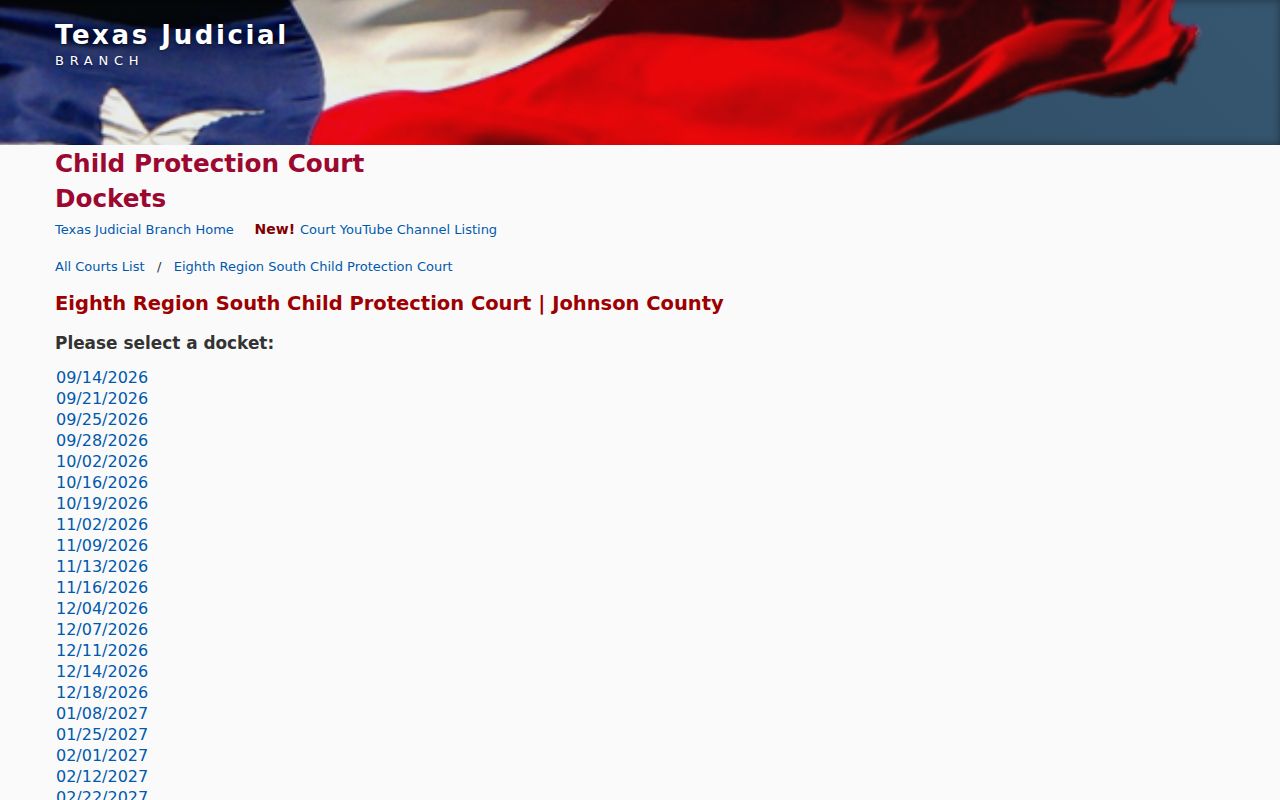
Venue comes first here. That point explains the state's separate date-selection route for Johnson County child-protection settings, which a search of Johnson Tyler alone may not reach. The state publishes this specialty schedule elsewhere, and protected juvenile details stay off it. Treat any listed date as a lead only. Confirm it with the responsible court before you rely on it.
One placeholder
The County Court at Law 1 standing-order record lists a remote juvenile detention plan. Read that entry narrowly, though. It does not mean every juvenile or child-protection hearing is remote.
Continuances, Resets, and Cancellations
A reset moves a court date, and the old setting usually lingers in the docket. Continuances show up in different ways. You might see a motion, an order, a short register note, or a fresh setting. A pass may simply mean the court never reached the case. So none of these labels, by itself, tells you a case was dismissed or wrapped up. To read a Johnson County court docket correctly, trace the chain from notice to appearance to signed order to later status.
When a date vanishes, check your case number, court, and location filters first. Cancellation is not the only explanation. Hunt for a later order. If the register and the setting block disagree, call the coordinator. Johnson County publishes no single Tyler refresh interval. So treat the docket as a record that can lag rather than a live feed.
Municipal Dates Stay Local
A city traffic ticket does not sit on the District Court calendar. Burleson and Cleburne post appearance details on their own municipal court pages. Every other city plus each JP precinct keeps its own lower-court settings. The citation names the issuing court. That clerk is your call. A docket search in the county portal that returns no result does not prove your citation lacks a date. A municipal or precinct system may hold it instead. The right chain is the citation's initial deadline, any later notice, and the local clerk's confirmation.
If You Miss a Court Setting
Move fast. Pull the newest case event, then call the clerk or coordinator for that court. Missing a criminal or traffic setting can trigger a failure-to-appear entry, a warrant, a bond consequence, or added process. On the civil side, the fallout might be an adverse order, a dismissal, or another result tied to that case. The court docket alone cannot settle it. Only the responsible court can tell you what actually occurred.
Missed a setting? Do not assume that paying, calling, or finding an old date automatically clears a failure-to-appear or warrant.
Contact the responsible Johnson County clerk or coordinator and your attorney, if represented, to learn the status and permitted next step.
Ask whether a new setting exists before appearing at a counter or courtroom.